Integrating Notes – February 2025
- Feb
- 28

My monthly newsletter seeks to connect you to sources of wisdom and inspiration in order to help you live a more integrated – joyful, purposeful, capable, and connected – life.
Dear Boston Brain Integration Community,
Every day in my office, I help courageous seekers move past defensive stuck points. The coping mechanisms that allow us to survive – Efforting, Shutting down, Denying, etc. – almost inevitably prevent our ability to thrive as we grow. Humans are ego-centric creatures, so it is easy to imagine that our struggles belong to us alone, but our ancestors live large inside of us.
What happens to our lineage when we heal? How does your personal growth impact your partner, family members, and children? How might it heal those who have come before you

Dr. Mariel Buqué is a first-generation Black Dominican psychologist, a world-renowned intergenerational trauma expert, and the author of the bestselling book Break the Cycle: A Guide to Healing Intergenerational Trauma. Her mission is to help reduce the recurrence of Intergenerational ACEs(Adverse Childhood Experiences) within communities of color.
“Trauma is the consequence of having undergone extreme distress that overwhelmed your mind, your body, and your spirit. This experience could have occurred once or it could be more chronic, meaning there were multiple instances of overwhelming distress.
Intergenerational trauma is the type of trauma that runs through your lineage and community through two modes of transmission: Genetic expressions, meaning your biology, and psychosocial experiences, meaning everything else that happens after you’re conceived.
This unique type of trauma keeps getting fed when trauma responses remain undisrupted and continue from generation to generation. But with intergenerational trauma, there’s also so much more that’s transmitted through families and communities, and that’s intergenerational wisdom and resilience.”

Diary of a Tap Dancer:
A Play By Ayodele Casel
Reflections by Elizabeth McIntire
We learn about our ancestors from the stories they tell. Too often, the stories of trauma are hidden and kept silent, and we all suffer. We can only learn from that which is named and shared.
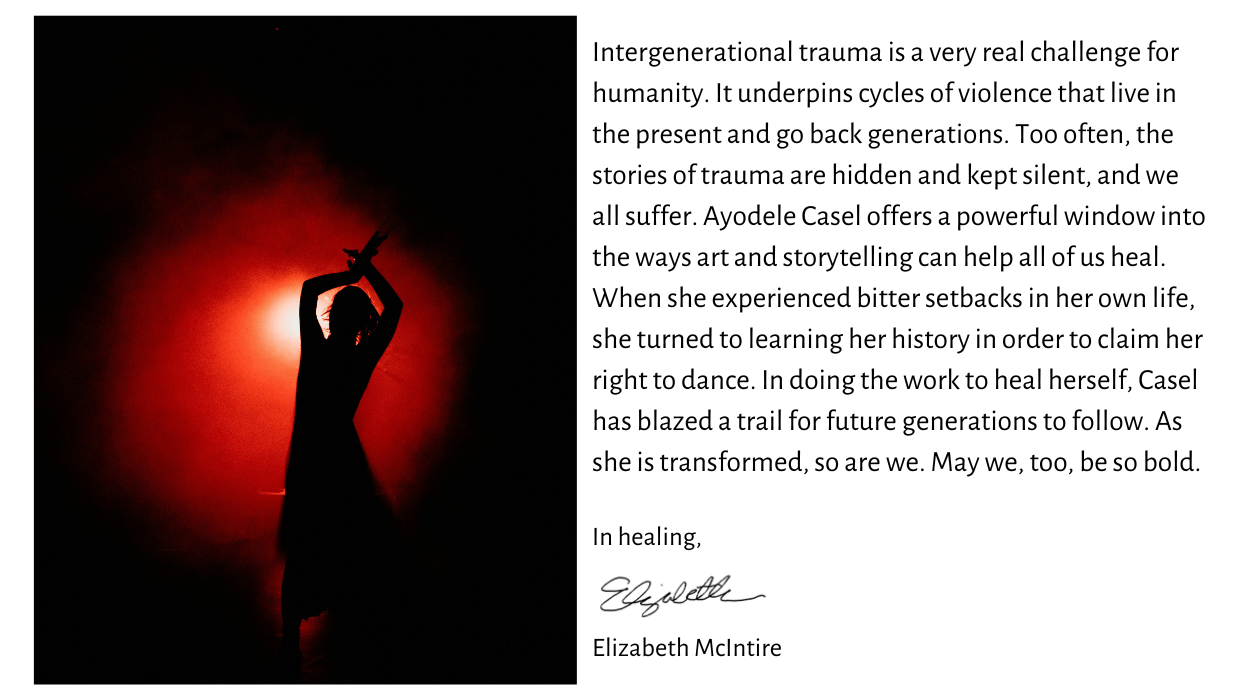
Ayodele Casel’s new show, Diary of a Tap Dancer, playing at the American Repertory Theatre in Cambridge this past December 2024, offers a powerful example of how art can heal creators, performers, and audiences. This “electric new play weaves together dance, narrative, and song to reveal the power of reclaiming language, culture, and one’s own identity.” As Casel portrays herself, we watch her grow up in The Bronx and Puerto Rico. We learn about her mother’s struggles and her grandmother’s isolation, and we see the history of racism underneath it all.
“I was called to write Diary of a Tap Dancer to amplify our voices, family stories and artistic lineages and to reflect the multitude of languages that we use to uplift and honor our cultural histories,” says Casel. A major theme in the piece is reclaiming the untold history of black women in tap from the first half of the twentieth century. “There’s a driving force now with the show about the relevancy of female empowerment, feminism, sexism, racial injustice, things that are so deeply rooted within generations,” says Ki’Leigh Williams. “I’m really hopeful that when people watch it, that they can take away an awakening.”
When we examine this work as more than art, we can see how the artistic medium itself is healing the performers: Casel portrays her younger self and integrates her fear, pain, joy, and growth.
Ayodele’s anger goes out to those in power, and her Cambridge audience does not escape her gaze. Her grief goes toward her dance ancestors, their images projected on the walls. As she beholds her young colleagues, we see her Joy. Her story swirls inside her as she tells it, expanding and integrating as she goes. Brimming with gratitude, determination, defiance and truth, she is healing before our eyes. “There are no shortcuts.”
Seven young tap dancers embody their ancestors in order to tell their stories and the history goes into their bodies before our eyes.
Tap in the present is in conversation with all of its history. These steps, this power, talks to a brutal past. All of their steps have brought them here to this. This is embodied resilience passed down from woman to woman, tapper to tapper. Ayodele has made a part for herself, for these young performers, and for her ancestors, where the world didn’t give her one: “Everyone who sees me will see them.”
As these performers step out of character and into themselves, they introduce themselves to us through dance. Their pride and joy and kinship is electric. This is intergenerational healing.
Let’s just notice…
- What part of your own history do you not know?
- How has learning about the struggles and triumphs of your ancestors helped you in times you felt lost or stuck?
- Do we have a responsibility to witness one another’s transformations? How does witnessing another’s growth lead to intergenerational healing?