

Integrating Notes – June/July 2025
- Sep
- 15
My monthly newsletter seeks to connect you to sources of wisdom and inspiration in order to help you live a more integrated – joyful, purposeful, capable, and connected – life.
Dear Boston Brain Integration Community,
At the end of April, I had the privilege of attending psychotherapist Esther Perel’s annual conference, Mating in the Metacrisis: Connection, Polarization, and Eroticism in a World on Edge. As a Brain Integrator, I have learned a great deal from Esther’s couples counseling podcast, Where Should We Begin? Her work with all sorts of individuals and relationships is creative and richly nuanced, and I appreciate her out of the box thinking. I especially respect Esther’s disciplined self-inquisition as she interrogates the value of her own work: where she did well in a session, and where she might have done something different. This radically honest feedback feels especially courageous to me at a time when perfection or denial are often the only models of leadership in view.

During the conference, we were focused on the powerful idea of the metacrisis, or multiple interconnected global crises that go beyond a single issue and compound each other. As Esther said, each of these systemic shifts and existential risks is intense: “we are dealing with climate change, the fraying of our social fabric, digital isolation, and many people yearning for meaningful bonds.” She began the conference by acknowledging that in a crisis, “our instinct is to contract, shut down, and withdraw.” Fighting this instinct is precisely the reason I went to the conference!
Amanda Ripley, whose work on high conflict I wrote about in this newsletter last October, was one of the speakers I was most excited to see. Ripley spoke powerfully about how we might use conflict to get stronger both individually and collectively. In my own work, I see the strength in my clients grow when they find their voice and speak their truth out loud, begin to imagine the previously unimaginable, and show up in the world in ways they never have before. Ripley teaches that high conflict used to be just 5% of all conflicts, but now it’s much more. This kind of conflict “eventually harms the thing you went into the conflict to protect” because it generates just two emotions that oscillate back and forth: anger → frustration. Good conflict offers many emotions and more questions. Healthy people feel. Good conflict gives us an opportunity to grow.
Have any of your personal struggles begun to feel intractable? You’re not alone. The internal and external and personal and political and environmental and more are all interwoven, whether we take the time to notice that or not. Fortunately, we humans can learn to understand ourselves and our world, noticing the emotions that arise in the complexity of our lives, processing and healing through both conflict and play. If I learned one thing from Esther’s conference, it was how much we have to learn from one another, how much more possible the hardest things feel when we tackle them together, and how vitally important play is in all of its forms.
References:
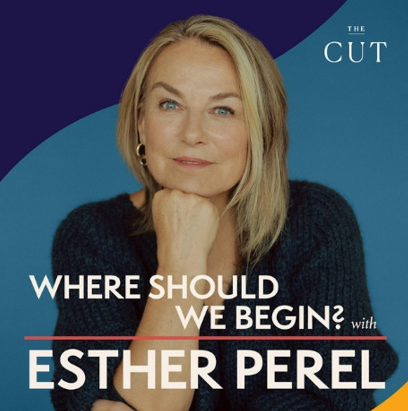
“Where Should We Begin?” is a podcast hosted by renowned psychotherapist Esther Perel, where she invites listeners into real-life couples therapy sessions. Each episode features a different couple grappling with relationship challenges, offering a unique glimpse into the complexities of intimacy, connection, and communication. The podcast explores a wide range of relationship dynamics, including infidelity, communication breakdowns, and the impact of past trauma on current relationships.
Esther Perel Conference: April 25-26, 2025
Mating in the Metacrisis: Connection, Polarization, and Eroticism in a World on Edge.
Addressing the challenges of increasing isolation, uncertainty, and social atrophy, and how these impact relationships. It will delve into how to cultivate true connection, foster agency and aliveness, and combat burnout in a world on edge

From a talk by Zach Taylor and David Kessler: Finding Meaning in the Metacrisis: Therapeutic Strategies for Helping Clients Through Anxiety and Grief

In my last newsletter, I shared a beautiful and intense poem, Meditation During the Sufferings and Deaths of Others, by Sharon Olds, which questions what it means to “deserve” all manner of things that happen to us, from physical abuse to friendship to the home where we live. As a Brain Integrator, I often hear stories of challenge and trauma, and part of our work is to sort through the particular scars of each chapter and notice where in the body and brain they left a mark.
In their talk, Finding Meaning in the Metacrisis: Therapeutic Strategies for Helping Clients Through Anxiety and Grief, Zach Taylor and David Kessler talked about the interaction between grief and anxiety.
“Grief is often rooted in love – something we connected to and lost. It’s rooted in the past. Anxiety is rooted in the present and future. It can also be about moving further away from something we value…When people speak anxious language, look for grief. When they speak of grief, look for anxiety.”
This valuable coaching is relevant to everyone. We all need sign posts to navigate the particular imprints of our own experiences and those around us.
After teaching us about grief and anxiety, Taylor and Kessler asked, “How do you know when the suffering is over and you’re living?”
As they explained it, “There are three things to look for.
- You can take risks and actively engage with the unknown;
- You can play unselfconscious and free;
- You can be creative, a practice that starts with safety and goes to mystery.”
Let’s just notice…
- As you face the metacrisis, what do you feel? Do you notice either grief or anxiety? How do these emotions influence each other inside of you?
- Are you able to take risks? What kinds of risks are you easily able to pursue, and which feel more dangerous?
- When was the last time you played?

From the talk by Isabel Behncke: Wild Joy: Evolution’s Gift of Play from Bonobos to Humans

One of the joys of Esther Perel’s interdisciplinary conference was getting to name the metacrisis, learn to live in the metacrisis, professionally address the metacrisis, and finally transcend the metacrisis! Ethologist Isabel Behncke spoke about how much we have to learn from primates like bonobos, who touch, play, groom, and bond, through face to face contact. “Visionary minds that can travel in time are a gift,” she says, “and they can make us anxious. It’s our minds that make us more stressed than bison, even bison who are standing with wolves a few feet away.”
I often speak with clients who are plagued by self-doubt and anticipatory anxiety. These existential threats are the challenges of our visionary minds.
How best, then, to stay grounded? Behncke says, “Animals that play together, stay together. Play is voluntary, pleasurable, exaggerated, repetitive, risky, exploratory, requires safety, has intrinsic value, and does not have obvious function. The reward of play is itself.” Before we rush to minimize pointless joy in accordance with the demands of capitalism, Behncke reminds us that “Play is prophylactic as well as antidote.” It is in the inherent uncertainty of it all that play is both dangerous and FUN. “Animals seek uncertainty in play. They hate it otherwise.”
Everywhere I look, I see humans trying to reduce uncertainty. We have predictive technologies everywhere, from weather apps to song recommendations to targeted advertising. Dating apps try to reduce the uncertainty of human connection by allowing you to vet future prospects from a safe distance. And so much more. What if we learned from the bonobos and resisted our brilliant human instincts for control through perfection, and instead allowed ourselves to play?
Let’s just notice…
- What might we learn from the bonobos about the value of uncertainty, about cultivating connection through play?
- How might that help all of us humans stick together at a time when the fracturing of our world threatens to tear us apart?


For anyone who may receive this newsletter and knows someone on a cancer journey.
A Boston Brain Integration Announcement
Boston Brain Integration is a proud partner of Connect and Thrive
CAT’s mission is to help women connect with a community of partners who can help them thrive.
CAT is a social impact company for cancer previvors, patients, thrivers, and caregivers. CAT empowers women on their personal healing journeys by connecting them to our Marketplace of reputable practitioners and curated products. CAT’s partners offer integrative therapies and healthy living products that help to prevent cancer, navigate a cancer diagnosis, and mitigate the risk of recurrence.
Reference: https://app.connect-and-thrive.com/marketplace/420
